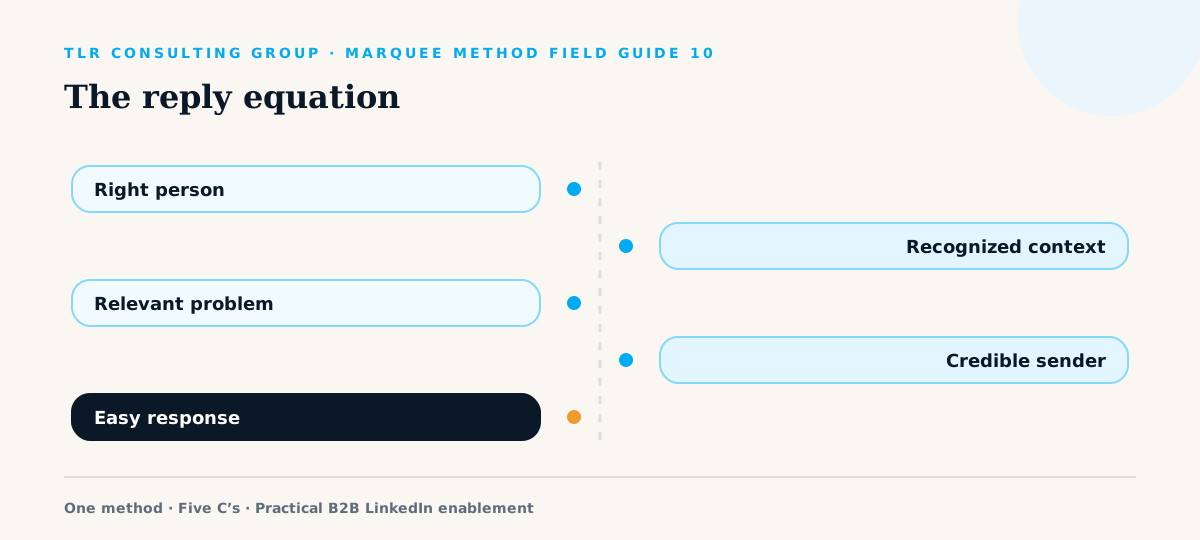
When LinkedIn messages get no replies, the message is only one possible cause. Silence can start with the wrong person, no familiarity, a weak profile, poor timing, or a request that asks too much of the relationship.
- Diagnose list, context, profile, and offer before wordsmithing.
- Open with a reason the message makes sense now.
- Ask for a small, relevant response.
- Measure reply quality by segment, not only overall rate.
Audit the conditions around the message
Review the person, account, trigger, relationship, profile, and proposed next step. Strong writing cannot rescue a message sent to someone who does not own the problem. A weak profile can also give the recipient no reason to trust a relevant message.
Separate connection messages, ordinary direct messages, and InMail in your reporting. LinkedIn provides response-rate reporting for InMail, described in LinkedIn’s InMail response-rate documentation. Your real objective is a useful business response.
Lead with context the recipient recognizes
Good context can be relational, behavioral, situational, or professional: a mutual introduction, a substantive public exchange, an event, a hiring signal, a disclosed initiative, or a problem visible in the recipient’s market. The context should explain why this person, why this subject, and why now.
Do not convert a trivial action into false urgency. Liking a broad post does not prove purchase intent. Use the action only if it creates a relevant, respectful bridge.
Make the message easy to process
Use a clear subject where applicable, one idea, short paragraphs, and plain language. Show enough credibility to justify the message, but do not paste a brochure. A useful structure is: recognized context, problem hypothesis, evidence or useful idea, and one easy question.
“You mentioned adoption dropped after the rollout. We often see that when the program trains posting but not the manager routine. Is reinforcement the constraint, or are employees still unsure what they can say?”
Shrink the first ask
A request for 30 minutes asks the recipient to evaluate relevance, trust, timing, and calendar cost at once. Start with a question they can answer in one sentence when the relationship is cold. If there is a clear active need or referral, a meeting can be appropriate sooner.
Provide value without attaching a library. One precise observation or resource matched to the problem is stronger than five links and a case-study dump.
Follow up with new information
One or two respectful follow-ups can be reasonable. Add a new insight, clarify the relevance, or close the loop. “Bumping this” asks the recipient to reread the same value proposition and usually teaches nothing.
Analyze replies by segment, context type, sender credibility, problem, and ask. Also record negative replies and silence; they reveal targeting and timing. For a broader system, see how to turn LinkedIn engagement into business conversations.
Code the failure before editing
Review at least 30 messages and classify them by audience fit, trigger, relationship, message type, value offered, ask, and outcome. Compare first messages with follow-ups. Separate connection notes, messages to existing connections, and InMail because the context and platform constraints differ.
A small sample can reveal concentration. If replies come from warm interactions and disappear in list-based outreach, the problem is audience and context. If relevant buyers read but do not answer, the value or ask may be weak.
Write for the cost of replying
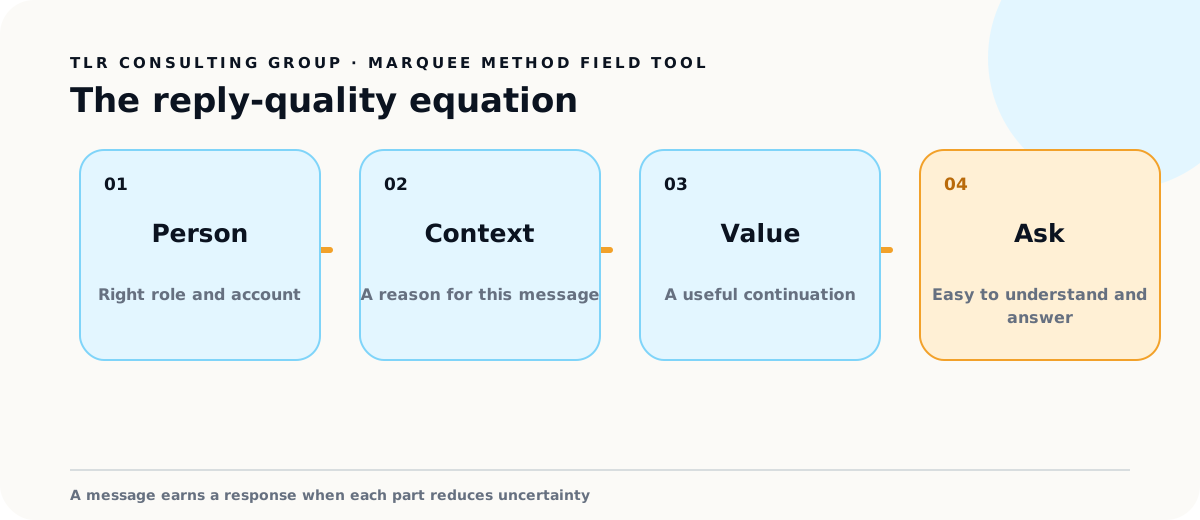
The recipient must understand who is writing, why now, what is useful, and what response is expected. Each extra claim increases the evaluation burden. Use one problem, one relevant observation, and one low-friction question.
“We help leading companies transform performance. Do you have 30 minutes next week?”
After“Your post on multi-site maintenance mentioned inconsistent failure codes. We use a short ownership map to resolve that before analytics work begins. Is that the same constraint your team is seeing?”
Match the channel to the relationship
A public comment is often the right first move when the buyer has shared an idea. A connection request is appropriate when there is genuine shared context. A direct message is appropriate when the continuation is useful and expected. InMail can reach a person outside the network, but paid access does not create relevance.
LinkedIn’s comparison of InMail and personalized invitations explains the functional difference between InMail and invitation notes. Build separate benchmarks for each message type and account plan.
Measure reply quality and next-step quality
Track positive replies, neutral replies, objections, referrals, and clear declines. A referral to the correct owner can be more valuable than a friendly response. Also track conversation-to-meeting and meeting-to-opportunity rates so message optimization does not stop at the inbox.
Document the source context for successful messages. Over time, the team should learn which public interactions, account signals, and shared experiences create legitimate reasons to talk.
Run a message teardown workshop
Select six anonymized messages: two that earned a useful reply, two that received a neutral or negative response, and two that received silence. For each, mark the recipient fit, context, value, credibility, ask, and reply cost. Do not reveal the outcome until the team predicts it.
Rewrite only the first weak element. If audience fit is wrong, do not polish the copy. If context is absent, identify a legitimate reason to wait or engage publicly first. If the ask is expensive, reduce it to a question or useful resource that matches the relationship.
Test the revised message within the same audience and channel. Compare positive replies and next-step quality, then add the strongest example to the team library with an explanation of why it worked.
Frequently asked questions
How long should a LinkedIn sales message be?
Use the shortest message that establishes context, relevance, and an easy next step. Many effective first messages fit in 50–120 words.
How many times should I follow up?
One or two useful follow-ups is a reasonable general practice. Stop when the person declines, asks you to stop, or the context no longer applies.
Why do personalized LinkedIn messages still fail?
Personalization is not relevance. A message can mention a personal detail while offering nothing connected to the recipient’s work or timing.
Research and method: This guide separates documented platform features and cited research from the operating recommendations used in The Marquee Method. LinkedIn analytics are estimates, research findings describe their stated samples, and platform features can change. Review the linked primary sources before implementing account-specific workflows.
Put it into practice
Build conversations, not message sequences.
Train your team to recognize signals, add context, and move from public relevance to useful dialogue.
Explore Team Workshops