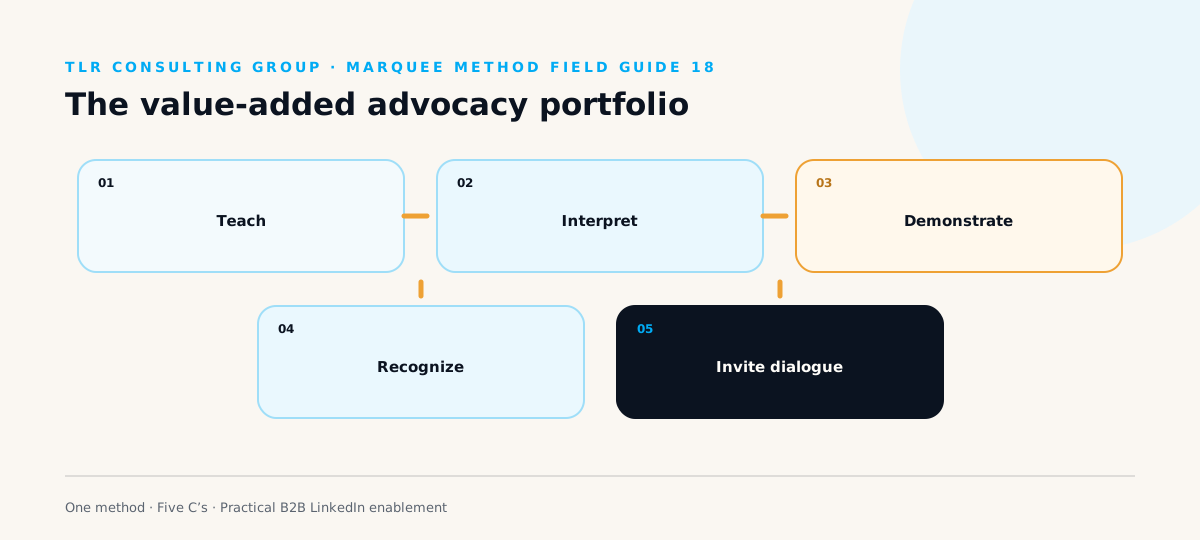
Useful B2B employee advocacy examples do more than promote the employer. They teach, interpret, demonstrate, recognize, or invite a professional conversation. The employee contributes context the company page cannot provide on its own.
- Use patterns as prompts, not scripts.
- Tie each post to the employee’s real access.
- Add context to company news.
- Protect customers, coworkers, and confidential information.
Examples that teach
- The recurring customer question: explain the decision behind a question you answer every week.
- The buyer checklist: share five conditions to inspect before a project or purchase.
- The misunderstood term: clarify a phrase the industry uses inconsistently.
Teaching works when the employee understands the subject firsthand and gives a complete useful answer. Avoid withholding the key point merely to create a sales conversation.
Examples that interpret
- The industry-news implication: explain what changed for a specific role.
- The tradeoff: show why two good goals conflict and how you decide.
- The pattern: describe a repeated observation and its limits.
Interpretation is thought leadership in practical form. It moves from “here is the news” to “here is what a qualified practitioner should consider next.”
Examples that demonstrate
- The process walkthrough: show a safe, nonconfidential part of how quality is created.
- The before-and-after lesson: focus on the changed decision, not only the result.
- The tool in context: explain where a tool helps and where it does not.
Check photos and screenshots for customer names, personal data, location detail, whiteboards, dashboards, unreleased product, and other sensitive material before publishing.
Examples that recognize people
- The colleague lesson: recognize what someone taught the team with permission.
- The customer milestone: celebrate the customer’s work without appropriating it or disclosing results.
- The candidate view: explain what good looks like in the role and why the work matters.
Recognition should be specific and sincere. Generic praise can feel performative; a concrete contribution shows why the person deserves attention.
Adapt examples without losing voice
For any pattern, answer: What did I observe? Why does it matter to my audience? What evidence can I safely share? What is my point of view? Which next step, if any, helps the reader?
LinkedIn’s guidance on employee thought leadership supports developing employee thought leadership rather than relying only on amplification. For a complete system of prompts, practice, governance, and measurement, use the LinkedIn employee advocacy program guide.
Evaluate examples by source quality
A strong example can be traced to work the employee did, observed, or studied. It names a real audience problem, contributes a useful point, and makes the limits clear. A weak example begins with a corporate message and adds the employee’s name.
For every example in the library, label the source: customer question, operating decision, implementation lesson, research interpretation, event observation, or career experience. This helps employees find their own material.
Adapt one example across roles
Suppose the company has learned that implementation ownership matters more than tool selection. An executive can explain the investment decision. A technical expert can show the ownership map. A customer leader can describe the handoff that usually fails. A seller can ask buyers how ownership is assigned in their organizations.
The central idea stays consistent while the contribution changes. This produces coherence without copied language.
Use an example quality rubric
| Criterion | Question | Pass condition |
|---|---|---|
| Earned | Why can this person say it? | Experience or source is clear |
| Useful | What can the reader do? | Decision, model, or implication |
| Specific | Could anyone post this? | Concrete context and language |
| Safe | Is permission clear? | No confidential or unsupported claim |
| Human | Does it sound like the person? | Natural voice and real judgment |
Measure examples by what they teach
Review which patterns employees can adapt, which produce relevant audience response, and which create useful conversations. Track reuse of the underlying format rather than copy-and-paste distribution. The program should become better at extracting expertise from work.
LinkedIn’s 2026 Employee Advocacy Analytics Guide supports adoption and audience measurement. The FTC’s employee endorsement guidance provides an important boundary when an employee endorses company products. Examples should include disclosure and permission scenarios, not only successful content.
Build an example library employees can trust
For each example, store the role, audience, source of the idea, content pattern, proof used, policy notes, and why the example worked. Include weak examples with an explanation of the problem. A library made only of top-performing posts teaches imitation rather than judgment.
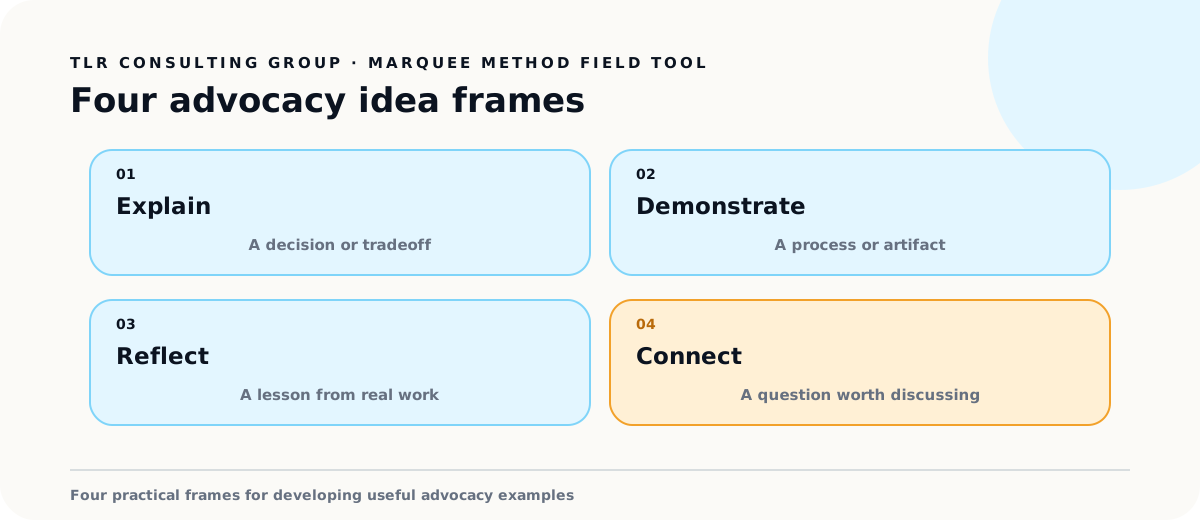
Tag examples by teaching job: explain, interpret, demonstrate, recognize, or invite dialogue. Also tag the evidence source and risk level. Employees should be able to find a relevant example without copying its wording.
Review the library quarterly. Remove examples that depend on obsolete platform features or unsupported claims. Add recent work from several roles and levels of comfort. The library should show many credible ways to participate, including comments, documents, event reflection, and co-created content.
For each strong example, add two adaptation prompts. Ask how the same pattern would change for a different role and what evidence another employee would need. This turns the library into a teaching system instead of a gallery.
Track which examples people use during practice and which produce original work. Retire examples that repeatedly generate imitation, even when the original post performed well.
Frequently asked questions
What is an example of employee advocacy?
An engineer explaining a recurring implementation tradeoff, a seller interpreting a buyer question, or an executive sharing a market point of view are all advocacy when they add authentic expertise.
Can employees share company content?
Yes, but adding role-relevant context is usually more useful than copying the company caption.
How do examples stay compliant?
Use clear policy zones, customer permission, confidential-information checks, approved claims, and a fast review path for sensitive subjects.
Research and method: This guide separates documented platform features and cited research from the operating recommendations used in The Marquee Method. LinkedIn analytics are estimates, research findings describe their stated samples, and platform features can change. Review the linked primary sources before implementing account-specific workflows.
Put it into practice
Give employees examples and the skill to create their own.
The LinkedIn Activation Sprint helps a pilot cohort turn real work into credible public participation.
See the LinkedIn Activation Sprint