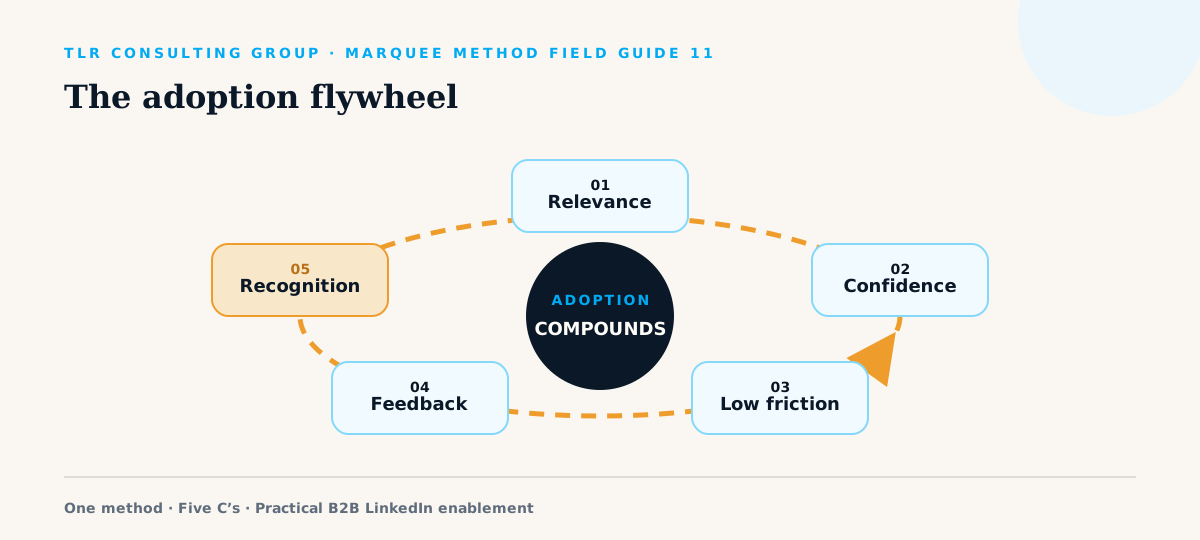
Employee advocacy adoption often drops after a strong launch because the company designed a campaign instead of a behavior system. Employees attended, understood, and intended to participate. Then regular work resumed, with no durable cue, support, or reward for the new behavior.
- Diagnose the specific adoption constraint.
- Reduce idea and approval friction.
- Reinforce through managers and peers.
- Recognize useful behavior, not raw posting volume.
Identify which adoption condition failed
Use five questions: Do employees understand why participation matters? Do they know what to do? Do they feel safe doing it? Can they do it within normal work? Do they see evidence that it helps? A failure in any one condition can look like “people are too busy.”
Interview active participants, inactive participants, managers, marketing, and legal separately. People may tell the program owner what sounds polite. Ask about the last time they intended to participate and what happened next.
Replace the content queue with an idea system
Many programs depend on marketing continuously feeding approved posts. Employees become distribution endpoints, and participation stops when the novelty or reminder cadence fades. Instead, teach people to notice ideas in their work and provide prompts that retrieve those ideas.
Useful sources include customer questions, project lessons, industry changes, mistakes, myths, decision criteria, behind-the-scenes process, and explanations employees repeat every week. Templates should shape an idea, not replace it.
Reduce risk without creating an approval bottleneck
Unclear rules create silence; universal preapproval creates delay. Define safe categories, sensitive categories, prohibited material, and escalation routes. Provide examples from the company’s actual environment.
For lower-risk content, use training and periodic review rather than line-by-line permission. For regulated or sensitive topics, design a faster expert review path. The advocacy policy guide shows how to structure practical guardrails.
Put reinforcement where work already happens
Managers and team leads do not need to inspect personal accounts. They can ask for ideas in existing meetings, recognize useful participation, and connect public insights to account or customer strategy. Peer cohorts and office hours provide safe practice without turning the program into surveillance.
LinkedIn’s social-selling activity framework highlights executive buy-in, training, planning, and early adopters as critical to social-selling change. The same logic applies here: visible sponsors and respected peers make the behavior legitimate.
- Weekly idea prompt
- Monthly office hours
- Peer examples
- Manager questions
- Fast escalation route
- Quarterly refresh
Reward usefulness and learning
Leaderboards based on posts or impressions encourage noise. Recognize useful explanations, buyer conversations, strong peer reviews, customer insights, and consistent practice. Share stories that show how participation helped the employee as well as the brand.
Measure activation by cohort and stage: trained, first action, repeated action, sustained routine, and champion. The drop between stages shows where the system leaks. A LinkedIn Activation Sprint can relaunch participation with a defined cohort and reinforcement period instead of another awareness campaign.
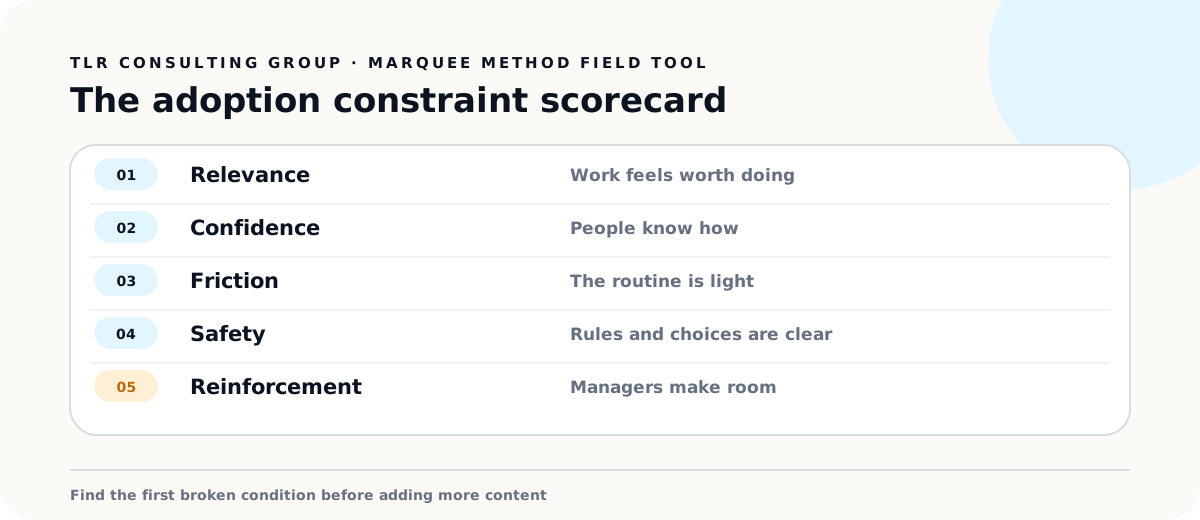
Diagnose adoption as a system
Score five conditions from one to five: relevance, confidence, friction, safety, and reinforcement. Ask participants for one example behind each score. Average scores can hide important differences, so review by role and manager.
If relevance is weak, employees do not see a connection to their work. If confidence is weak, they need examples and practice. If friction is high, the workflow asks for too much. If safety is unclear, policy or culture is blocking action. If reinforcement is absent, participation loses to urgent work.
Match the intervention to the constraint
| Constraint | Useful intervention | Common mistake |
|---|---|---|
| Low relevance | Connect activity to role outcomes | More reminders |
| Low confidence | Practice with feedback | More templates |
| High friction | Shorten capture and approval | Add another tool |
| Low safety | Plain-language scenarios | Longer policy |
| Weak reinforcement | Manager review and examples | Public leaderboard |
Use cohort evidence, not participation pressure
Review activation by cohort, role, manager, and week. Interview active and inactive employees separately. Active people reveal which conditions work. Inactive people reveal where the system fails. Protect candor by asking about the process rather than who is committed enough.
LinkedIn’s 2026 Employee Advocacy Analytics Guide frames advocacy measurement around adoption, education, recommendations, and audience insight. Use adoption data to improve support. Avoid turning it into a public compliance score.
Run a 30-day adoption repair
Week one identifies the first constraint. Week two removes one source of friction and publishes two strong internal examples. Week three gives managers a short coaching question and holds an office hour. Week four compares cohort behavior and interviews participants again.
Keep the smallest intervention that improves the behavior. The goal is a routine employees can sustain while doing their real jobs. Expansion should wait until the pilot cohort can participate without extraordinary program effort.
Use an adoption interview guide
Ask active and inactive participants the same questions. What part of the program helps your work? Which action feels hardest? Where do you hesitate? How long does participation take? What support do you use? What would make the next action easier? Ask for a recent example after every general answer.
Code responses into relevance, confidence, friction, safety, and reinforcement. Count themes, but preserve representative language so leaders can understand the experience behind the score. Compare roles and managers before assuming one intervention fits everyone.
Choose the first constraint that appears repeatedly and can be changed within 30 days. Publish the change and tell participants which evidence led to it. Closing that feedback loop is itself an adoption signal.
Frequently asked questions
Why do employees stop participating in advocacy programs?
Common causes include unclear relevance, lack of confidence, approval friction, weak manager reinforcement, generic content, and no visible value to the employee.
Should participation be mandatory?
Mandatory personal posting creates trust and authenticity risks. Set expectations for role-relevant professional participation where appropriate, but provide choice in voice and format.
How do you re-engage inactive employees?
Interview them, remove the actual friction, restart with a small achievable action, and use respected peers to demonstrate useful participation.
Research and method: This guide separates documented platform features and cited research from the operating recommendations used in The Marquee Method. LinkedIn analytics are estimates, research findings describe their stated samples, and platform features can change. Review the linked primary sources before implementing account-specific workflows.
Put it into practice
Rebuild adoption around real work.
The LinkedIn Activation Sprint gives a focused cohort the skills, support, and weekly rhythm to move from intent to visible behavior.
See the LinkedIn Activation Sprint