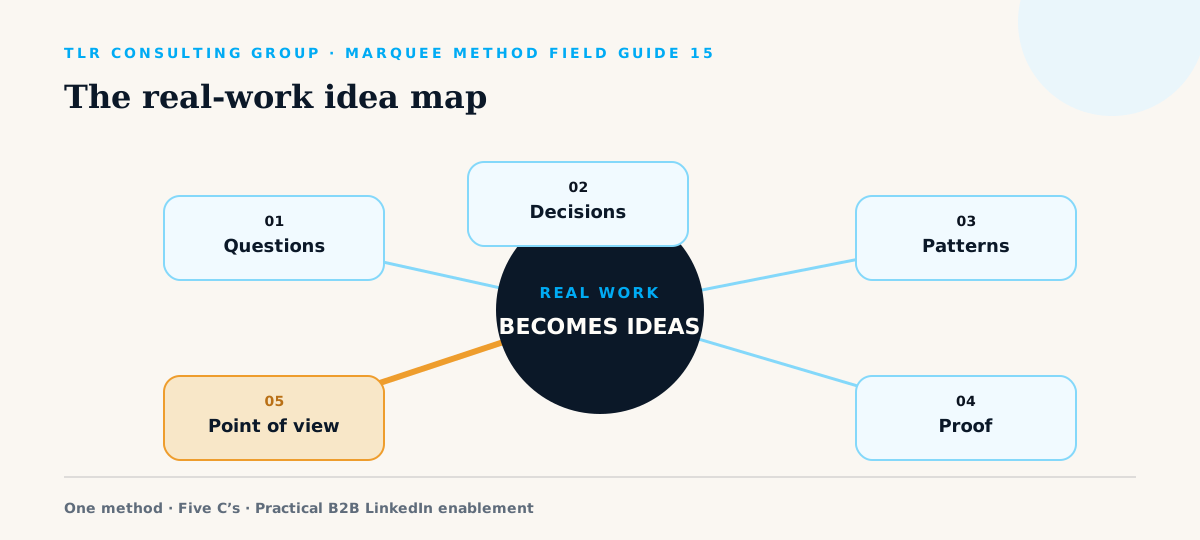
Useful B2B LinkedIn thought leadership ideas are usually hidden in work you already did: a question you answered, a tradeoff you managed, a pattern you noticed, a mistake you corrected, or a decision you can explain. Retrieve that judgment while the context and evidence are still fresh.
- Capture moments with tension, evidence, or change.
- Turn each idea into one useful claim.
- Protect customer and company confidentiality.
- Match the idea to a clear buyer question.
Six ideas from customer questions
- The question buyers ask too late.
- The question that reveals whether a project is ready.
- A common question with an unhelpful yes-or-no answer.
- The hidden question behind a frequent objection.
- A question your best customers ask differently.
- The question teams should ask before comparing vendors.
For each, explain why the question matters, the context that changes the answer, and one decision rule. Remove identifying details unless you have explicit permission.
Six ideas from decisions and tradeoffs
- A decision where speed and quality were in tension.
- What you would fund first with a limited budget.
- The metric you would not optimize in isolation.
- A popular best practice you use only under certain conditions.
- The small decision that prevents an expensive problem.
- What to standardize while preserving necessary flexibility.
Tradeoffs demonstrate judgment because they acknowledge constraints. State the conditions that would change your recommendation; nuance increases usefulness.
Six ideas from patterns and data
- A pattern across recent customer conversations.
- A signal that appears before a project stalls.
- A metric whose definition is commonly misunderstood.
- What changed in the last year and what did not.
- An unexpected segment or use case in your data.
- A correlation worth investigating without claiming causation.
Show the scope and limitations of the evidence. “Across 12 implementations we supported” is more credible than presenting a small observation as a universal law.
Six ideas from implementation and mistakes
- A lesson that only became obvious after rollout.
- The handoff where good strategies break.
- A mistake your team no longer makes.
- A checklist created after a near miss.
- What the plan underestimated.
- A process that looked efficient but damaged the outcome.
Useful failure stories do not require confession theater. Focus on the mechanism, correction, and lesson. Protect the people and customers involved.
Six ideas from point of view and future change
- A term your industry uses too loosely.
- A prediction with clear assumptions.
- What leaders should stop delegating.
- A capability that will matter more than a tool.
- What buyers should demand from your category.
- The belief your experience has changed.
The 2024 Edelman–LinkedIn B2B thought-leadership research describes strong thought leadership as expert, insightful, and distinctive. Distinctive does not mean provocative for attention; it means the reader can identify the judgment behind the idea.
Write one claim, one reason, one concrete example, one implication for the reader, and one honest question if dialogue would improve the idea.
For the system around these prompts, use the B2B LinkedIn content strategy guide.
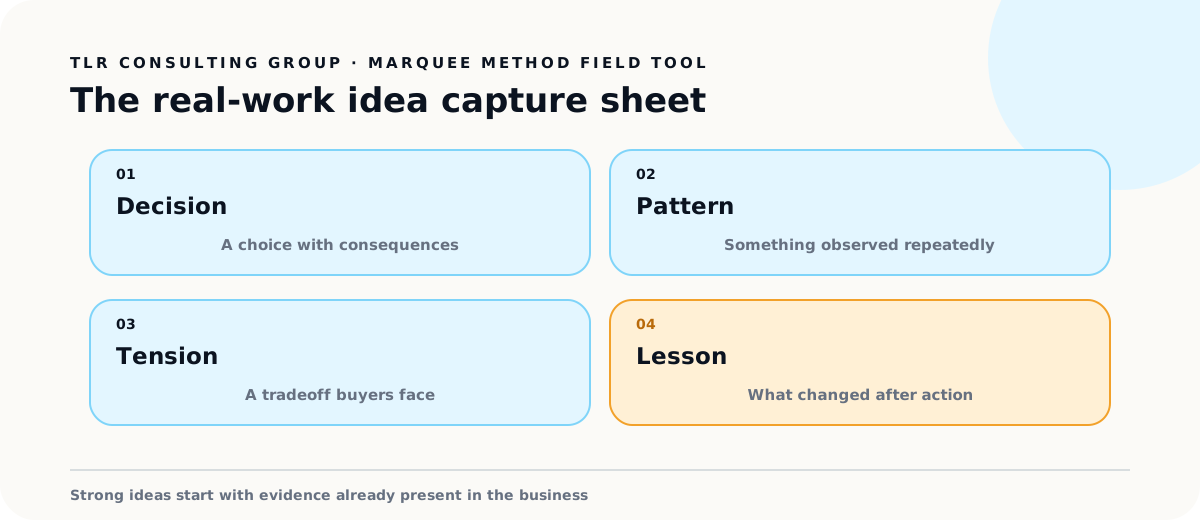
Use an idea brief before drafting
For each idea, write the intended reader, the situation they face, the claim, the evidence, the implication, and what must remain confidential. If the claim cannot be stated in one clear sentence, the idea is not ready.
This brief separates source material from format. The same strong idea could become a short post, document, article, webinar segment, sales conversation, or internal training example.
Build ideas from five evidence sources
| Source | Capture question | Proof available |
|---|---|---|
| Customer conversation | Which question keeps returning? | Anonymous pattern or approved quote |
| Operating decision | What tradeoff did we accept? | Decision criteria and result |
| Implementation | Where did the plan meet reality? | Lesson, sequence, artifact |
| Market research | What changed our view? | Primary source and date |
| Team review | What do we now do differently? | Before and after process |
Score ideas for usefulness
Rate each idea from one to five on audience relevance, originality, evidence, practical value, and the author’s earned authority. A high score does not guarantee performance. It forces the editorial team to explain why the idea deserves the reader’s time.
Reject generic topics even when they are popular. Improve a weak evidence score by interviewing an expert or finding a primary source. Improve a weak practical-value score by adding a decision rule, example, or tool.
Connect the portfolio to buyer learning
The 2025 Edelman–LinkedIn B2B Thought Leadership Impact Report found that hidden buyers value thought leadership that informs or challenges their perspective. The 2024 Edelman–LinkedIn B2B Thought Leadership research similarly emphasizes ideas that cause buyers to reconsider assumptions. Use those findings as a quality challenge, not as permission to be provocative without evidence.
Review the monthly portfolio for repeated topics, unsupported claims, missing stakeholder concerns, and absent proof. The goal is a body of work that helps a buying group make better decisions.
Hold a 45-minute idea-mining session
Invite one expert and one interviewer. Spend ten minutes on recent decisions, ten on repeated customer questions, ten on implementation surprises, and ten on market changes. Use the final five minutes to select the strongest idea and complete the brief.
Do not draft during the interview. Capture exact examples, tradeoffs, uncertainty, and available proof. Ask what a smart peer might disagree with and what the expert would never claim. Mark anything that requires permission or fact checking.
Afterward, the editor turns the material into two or three possible claims. The expert chooses the one that reflects their judgment. Unused material returns to the idea library with source, date, audience, and confidentiality notes.
Frequently asked questions
What qualifies as B2B thought leadership?
A useful, evidence-aware point of view that helps a professional audience understand a problem or make a decision differently.
How do I find ideas if my industry is boring?
Look for costly decisions, misunderstood tradeoffs, recurring questions, implementation failures, and changing constraints. Boring industries often contain high-stakes expertise.
Can I share customer stories without naming the customer?
Sometimes, but anonymization may not remove all identifying or confidential detail. Follow company policy and get permission when the story is sensitive or recognizable.
Research and method: This guide separates documented platform features and cited research from the operating recommendations used in The Marquee Method. LinkedIn analytics are estimates, research findings describe their stated samples, and platform features can change. Review the linked primary sources before implementing account-specific workflows.
Put it into practice
Keep trained teams developing useful ideas.
The Marquee Academy helps trained teams continue the work with practical prompts, templates, guided application, and ongoing learning.
See how the Academy supports trained teams