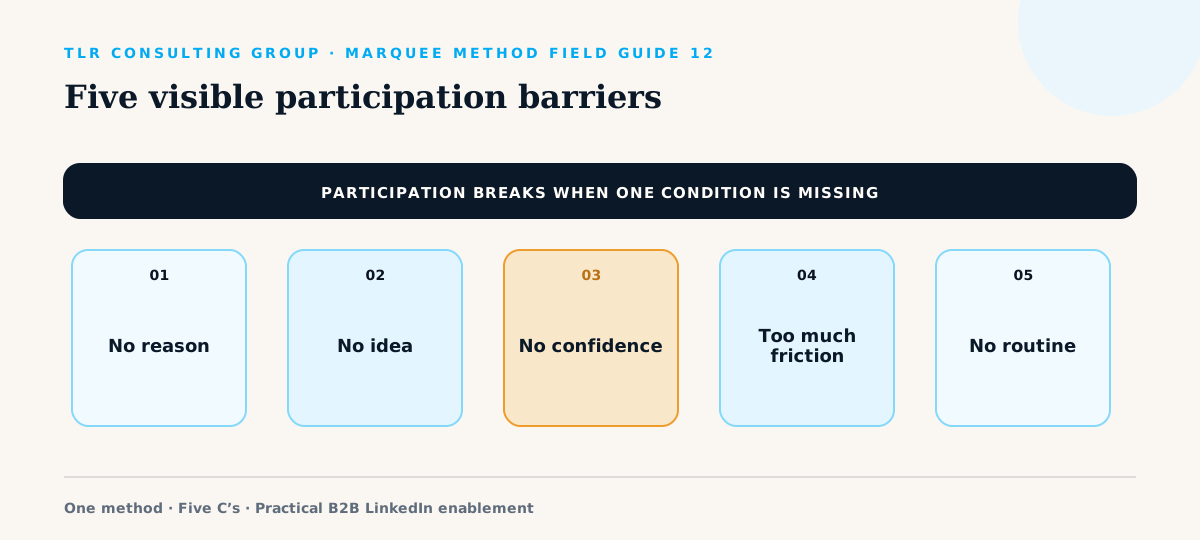
When employees won’t post on LinkedIn, telling them to update their profile or sending more corporate copy usually misses the cause. Posting is a content and consistency behavior. The right intervention depends on whether the employee lacks relevance, ideas, confidence, safety, time, or reinforcement.
- Do not diagnose silence as a profile problem.
- Ask what happens at the moment of posting.
- Teach idea retrieval and low-risk practice.
- Make participation useful to the employee’s role.
Separate willingness from ability
Some employees do not want a public professional presence, and that choice deserves respect. Others want to participate but cannot translate expertise into a post, fear saying the wrong thing, dislike self-promotion, or cannot see how posting helps their work.
Ask two questions separately: “Would this be valuable if it felt safe and manageable?” and “What makes it difficult today?” The first tests motivation; the second reveals the constraint.
Diagnose six common blockers
| What you hear | Likely blocker | Useful response |
|---|---|---|
| “I have nothing to say.” | Idea retrieval | Use prompts from customer questions and work moments |
| “I am not a writer.” | Confidence or format | Teach a simple structure; allow comments or short posts |
| “Legal will hate this.” | Unclear guardrails | Clarify safe, ask-first, and prohibited content |
| “I do not have time.” | Workflow or priority | Set a fifteen-minute daily routine and capture ideas during work |
| “It feels self-promotional.” | Identity | Frame participation as teaching and helping |
| “What is in it for me?” | Relevance | Connect the skill to reputation, customers, recruiting, or career |
Create the first safe win
Do not begin with a polished thought-leadership essay. Start with a thoughtful comment, a short explanation of a recurring question, a lesson from a recent project, or a response to industry news. Give employees time to draft, discuss, and revise without public pressure.
Use real examples from colleagues with similar roles. A technical employee is more likely to learn from another credible technical employee than from a creator whose job is marketing. LinkedIn’s guidance on employee thought leadership emphasizes developing employee expertise instead of treating people only as an amplification channel.
Remove production friction
Provide a capture place, prompts, optional structures, approved source material, accessibility guidance, and a clear review path for sensitive subjects. Schedule short working sessions where people leave with one complete idea rather than another slide deck.
AI can help organize notes, create alternatives, and edit for clarity, but require the employee to verify facts and restore their own voice. Generic generated copy can increase output while decreasing trust.
Build consistency without coercion
Set a realistic floor such as one useful public contribution per week, where a contribution may be a comment, post, or conversation depending on the role. Use peer cohorts, manager encouragement, and office hours. Celebrate helpfulness, not virality.
When silence is widespread, use a structured LinkedIn Activation Sprint. When the issue is uncertain, select “executives are not posting” or the closest symptom in the Marquee Diagnostic; the result prioritizes content and consistency instead of unrelated profile edits.
Ask what “will not post” means
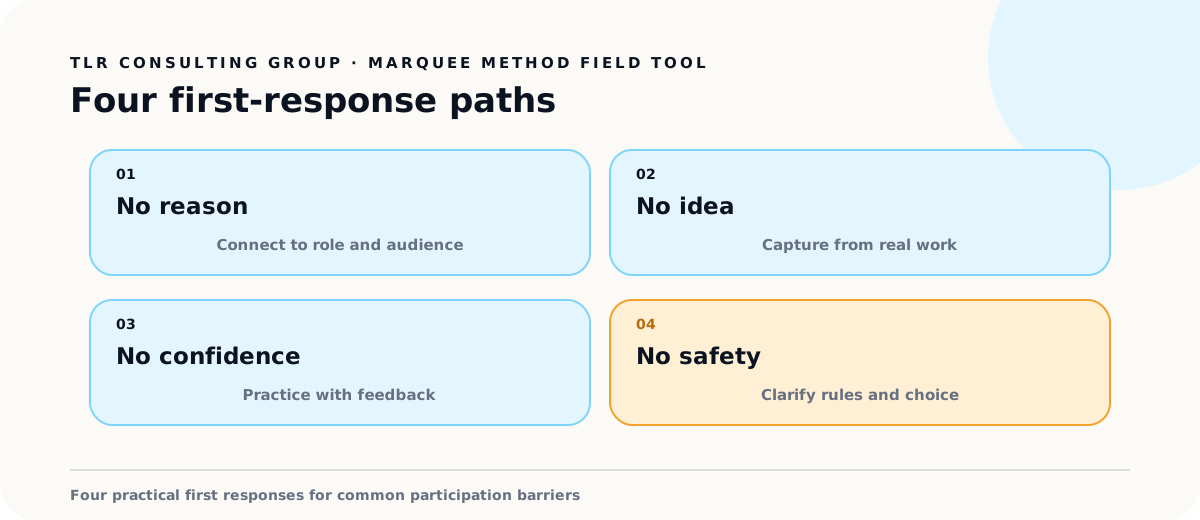
Interview employees privately and offer specific options: I do not see the value; I do not know what to say; I worry about mistakes; I lack time; I dislike public posting; I do not want the company to direct my profile. Allow more than one answer.
This distinction matters. Profile rewrites do not solve a time or safety problem. More prompts do not solve a lack of purpose. A publishing quota makes a choice problem worse.
Respect legitimate non-participation
Employee advocacy depends on personal professional identity. Participation should be voluntary, with several ways to contribute. An employee may comment, help an expert develop an idea, speak in a webinar, provide internal source material, or build a relevant network without publishing original posts.
State what the program will never require: copied posts, undisclosed endorsements, confidential examples, automated engagement, or manager access to personal accounts. This makes the invitation more credible.
Give each blocker a practical response
| Employee says | Program response | Evidence of progress |
|---|---|---|
| “I have no time” | Capture from existing meetings | Ideas collected in ten minutes |
| “I have nothing to say” | Interview around real decisions | Two earned observations |
| “I might get it wrong” | Safe, ask-first, restricted examples | Can classify scenarios |
| “This is not my job” | Connect to role outcomes | Chooses a useful behavior |
Measure voluntary confidence and behavior
Track opt-in rate, confidence by skill, time to first useful action, repeated participation, and employee-reported friction. Pair this with audience and conversation evidence. A high opt-in rate followed by silence points to execution friction. A low opt-in rate points to trust, relevance, or sponsorship.
When employees discuss company products, the program also needs clear disclosure guidance. The FTC’s employee endorsement guidance says an employment relationship can be material and that listing an employer on the profile may not be enough for an endorsement.
Offer a participation menu
Give employees several voluntary options. They can improve their profile, build a relevant network, add thoughtful comments, contribute source material, join an interview, speak at an event, co-create a document, or publish an original post. Explain the time, support, and privacy implications of each choice.
Ask each participant to select one behavior for four weeks. The program lead supplies a practical starting point and one feedback session. Employees can change or stop the behavior without penalty.
Review which options produce confidence, audience value, and sustainable effort. The company gains a broader participation model, and employees retain control over how they use their professional identity. Original posting can remain one useful path instead of the only visible definition of commitment.
Frequently asked questions
Should companies require employees to post on LinkedIn?
Personal posting should not be coerced. Companies can create role-relevant expectations, training, and support while preserving employee choice and authentic voice.
What if employees say they have no content ideas?
Teach them to retrieve ideas from customer questions, project lessons, decisions, tradeoffs, mistakes, data, and repeated explanations.
Can AI solve employee posting adoption?
AI can reduce drafting friction, but it cannot supply firsthand expertise, judgment, motivation, or trust. Use it as an editor and organizer with human verification.
Research and method: This guide separates documented platform features and cited research from the operating recommendations used in The Marquee Method. LinkedIn analytics are estimates, research findings describe their stated samples, and platform features can change. Review the linked primary sources before implementing account-specific workflows.
Put it into practice
Turn willing experts into confident participants.
The 45-day LinkedIn Activation Sprint helps one pilot cohort build practical skills, use them in real work, and establish a repeatable weekly routine.
Explore the LinkedIn Activation Sprint