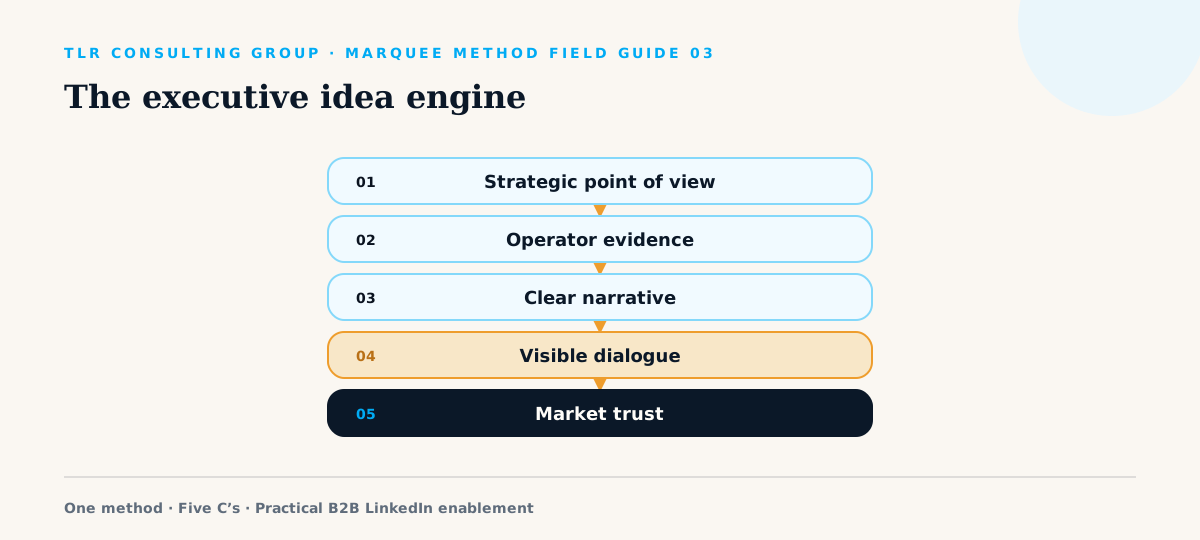
Executive thought leadership on LinkedIn gives the market direct access to a leader’s judgment. It helps buyers understand how your company sees the market, gives employees language for important ideas, and makes leadership accessible before a sales conversation.
- Choose a narrow territory the executive has earned.
- Capture ideas from decisions and conversations already happening.
- Use support to reduce friction without outsourcing the point of view.
- Measure buyer and stakeholder response, not executive fame.
Start with an earned point of view
Focus the executive’s territory where three things overlap: the company’s commercial priorities, the audience’s unresolved questions, and the executive’s firsthand operating experience.
LinkedIn’s executive thought-leadership guidance emphasizes authenticity and relevance in executive visibility. That requires specificity. “Digital transformation matters” is a topic. “Why plant leaders should fund data cleanup before predictive maintenance” is a point of view with stakes.
Write a territory statement: “I help [audience] think differently about [problem] by drawing on [earned experience].” Use it to reject fashionable subjects the executive cannot illuminate.
Build an idea-capture workflow around the calendar
The raw material already exists in customer calls, board discussions, internal reviews, conference notes, product tradeoffs, hiring decisions, and questions from employees. Add a ten-minute capture habit after high-signal moments: What surprised us? What did we decide? What do most people misunderstand? What evidence changed our view?
A communications partner can interview, organize, edit, fact-check, and schedule. The executive must still supply the judgment. The clean line is this: support can improve expression; it should not invent conviction.
- Monthly 30-minute interview
- Shared idea inbox
- Three approved territories
- Evidence and examples
- Executive final edit
- Comment time reserved
Use a varied editorial portfolio
Build a balanced monthly portfolio with market analysis, operator lessons, industry interpretation, customer stories used with permission, and answers to recurring questions. Most posts do not need a grand prediction.
The 2024 Edelman–LinkedIn B2B thought-leadership research frames thought leadership as content that offers expertise, insight, and a distinct point of view. A capable buyer should learn something or reconsider a decision after reading it.
Give readers a specific idea, credible support, and room to respond.
Turn publishing into dialogue
Leadership visibility compounds when the executive participates after publishing. Reply to substantive comments. Ask a follow-up question. Recognize employees and customers who add context. Comment on relevant ideas from peers and buyers between posts.
LinkedIn describes feed relevance as a combination of content, identity, activity, and the conversations around a post. See LinkedIn’s explanation of how the feed ranks content and LinkedIn’s relevance and member-experience guidance. Executive thought leadership works best when the leader participates in that exchange.
Measure market movement, not celebrity
Track who responds: buyer roles, customers, partners, candidates, analysts, and employees. Record high-value signals such as invitations to speak, sales references to a post, recruiting conversations, employee reuse of an idea, and target-account engagement. Reach without relevance can make the chart look healthy while the strategy fails.
For teams with willing leaders but no repeatable workflow, a company-wide enablement system can connect executive visibility with employee and sales participation instead of running it as a separate communications project.
Define a defensible editorial territory
An editorial territory should be narrow enough for the executive to own and broad enough to support a year of useful thinking. Build it from recurring decisions, not corporate themes. A manufacturing CEO may own capital allocation under uncertainty. A services leader may own the conditions that make transformation programs stick.
Test each proposed territory with four questions: Does the leader make real decisions here? Can the team supply evidence? Does the intended audience face meaningful consequences? Can the leader disagree with a common assumption without manufacturing controversy? A territory that fails two of those tests will produce generic content.
Turn executive access into source material
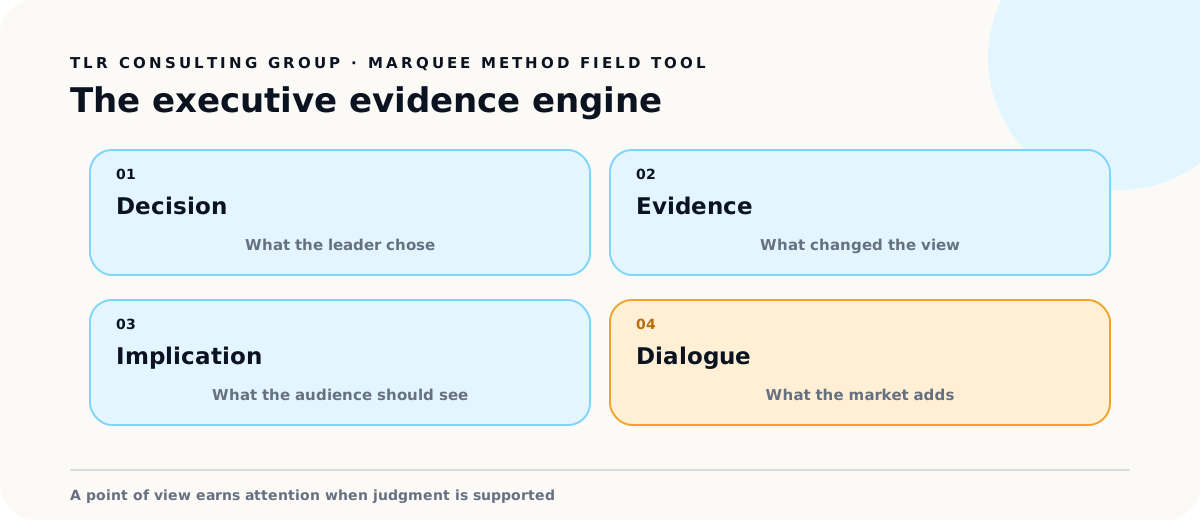
Use a monthly evidence interview instead of a request for “content ideas.” Ask what decision consumed time, which assumption proved wrong, what customer pattern appeared, and what tradeoff the team accepted. Capture the example, supporting facts, uncertainty, and audience implication.
What happened? Why did it matter? What options were considered? Which evidence changed the decision? What would a peer get wrong? What can be shared safely? The answers produce a credible draft without asking the executive to become a full-time writer.
Match the idea to the buying group
The visible buyer is only part of the audience. Finance, procurement, legal, compliance, and operations may influence a decision without joining early sales calls. The 2025 Edelman–LinkedIn B2B Thought Leadership Impact Report surveyed nearly 2,000 management-level professionals and found that hidden buyers actively consume thought leadership and use it to evaluate vendors.
Write with those readers in mind. An executive post about innovation should address implementation risk. A post about growth should explain resource tradeoffs. A post about a new capability should show how the organization learned, not only what it launched. This makes the idea useful inside the buyer’s internal conversation.
Use an executive scorecard that protects quality
Review a six- to eight-week body of work. Track intended-audience reach, saves, sends, substantive comments, relevant profile visits, inbound conversations, employee reuse, and account-team evidence. LinkedIn’s current post analytics documentation documents which metrics LinkedIn provides and notes that the counts are estimates.
Pair the numbers with qualitative review. Which idea did buyers repeat? Which post prompted a useful disagreement? Which claim lacked proof? Which audience was absent? The purpose is better judgment in public, not a rising follower count at any cost.
Use a publication readiness review
Before publication, the executive or editor should answer seven questions. Is the intended reader clear? Is the central claim specific? Has the leader earned the right to make it? Is the evidence named and current? Are uncertainty and limits stated? Does the idea help a buyer make a decision? Can every sensitive detail be shared?
Then read the draft aloud. Remove sentences the executive would never say in a room. Replace abstract business language with the actual decision, constraint, or consequence. Verify every number against the primary source and preserve the date and sample context.
The final approval should belong to the executive. Support can reduce friction and improve clarity. Accountability for the point of view remains with the named author.
Frequently asked questions
How often should an executive post on LinkedIn?
One or two substantive posts per week can be enough when paired with meaningful participation. Choose a cadence the executive can sustain and support.
Should executives use ghostwriters?
Editorial and interview support can reduce friction, but the point of view, examples, and final judgment should remain the executive’s.
What should an executive avoid posting?
Avoid confidential information, unverified claims, generic commentary outside the executive’s expertise, and sensitive customer stories without permission.
Research and method: This guide separates documented platform features and cited research from the operating recommendations used in The Marquee Method. LinkedIn analytics are estimates, research findings describe their stated samples, and platform features can change. Review the linked primary sources before implementing account-specific workflows.
Put it into practice
Make executive visibility part of the company system.
Install the positioning, capture workflow, editorial standards, and reinforcement that keep leadership visible.
See The Marquee Program