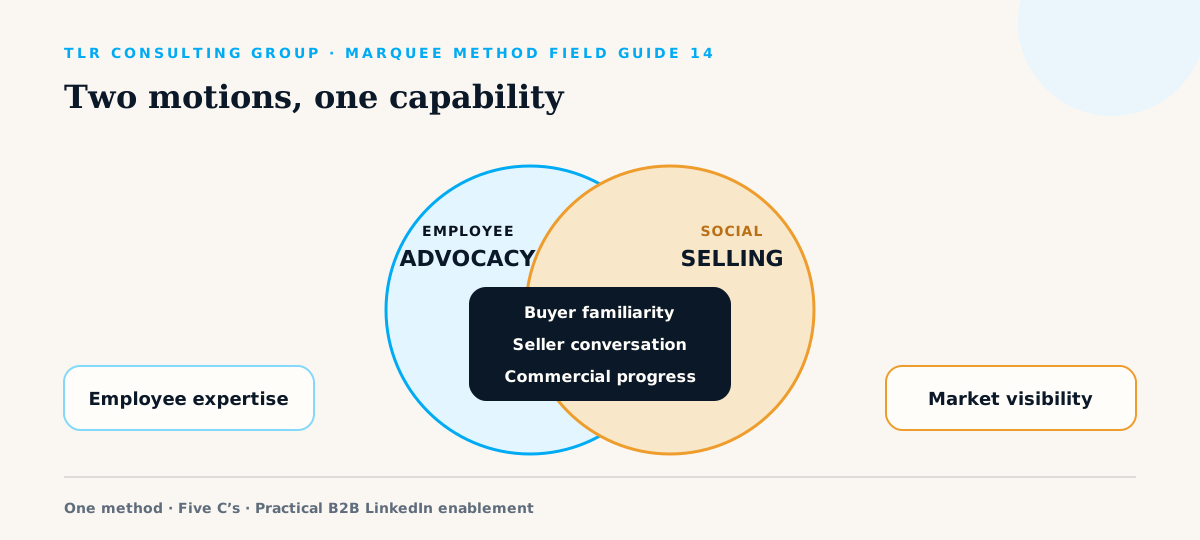
Employee advocacy and social selling overlap, but they are not interchangeable. Employee advocacy helps a broader group of employees strengthen trust and visibility through professional participation. Social selling focuses more directly on how customer-facing people use networks, insight, and conversations to support revenue.
- Advocacy is broader than sales participation.
- Social selling requires account and conversation discipline.
- Both depend on credibility, relevant networks, useful content, and consistency.
- Use shared training with role-specific outcomes.
Compare the primary jobs
| Dimension | Employee advocacy | Social selling |
|---|---|---|
| Primary goal | Trust, visibility, expertise, culture, reach | Access, insight, relationships, pipeline influence |
| Participants | Employees across functions | Sales and other customer-facing roles |
| Core activity | Sharing expertise and participating professionally | Researching, connecting, engaging, and conversing with buyers |
| Measurement | Activation, audience, engagement, business influence | Acceptance, replies, meetings, account engagement, pipeline influence |
The boundary is not rigid. A solutions engineer can advocate and support sales. An executive post can strengthen employer brand and open a buyer conversation.
Recognize the shared foundation
Both motions fail when the profile lacks credibility, the network is irrelevant, the content is generic, conversations are extractive, or participation is inconsistent. A shared five-C system covers Credibility, Connections, Content, Conversations, and Consistency while leaving room for each role to apply it differently.
A salesperson may spend more time on target-account research and contextual messaging. A technical expert may spend more time explaining decisions and participating in domain conversations.
Avoid the two common category mistakes
The first mistake is treating advocacy as a sales channel and measuring every employee by leads. This discourages technical, operational, and cultural contributions whose value is trust or access. The second is treating social selling as content posting and ignoring account selection, listening, and direct dialogue.
LinkedIn’s social-selling activity framework frames successful social-selling adoption around executive support, training, goals, and early adopters. Those elements help both motions, but the role outcomes still need to be explicit.
Design one program with role-specific tracks
Train the shared foundation together, then provide practice by role. Executives develop point of view and strategic dialogue. Sellers build relevant networks and conversation paths. Experts turn operating experience into useful explanations. Marketing creates prompts, proof, and measurement. Managers reinforce habits.
- Shared method
- Role outcomes
- Common guardrails
- Different examples
- Aligned metrics
- One reporting view
Choose where to start
Start with social selling when the commercial team has clear target accounts but weak access, familiarity, or replies. Start with advocacy when valuable expertise is distributed across the company and brand trust or organic visibility is weak. Start with an integrated pilot when leadership, sales, marketing, and experts must work together around the same market.
Compare the LinkedIn Activation Sprint, Team Workshop, and Marquee Program based on scope and reinforcement needs.
Define the two disciplines precisely
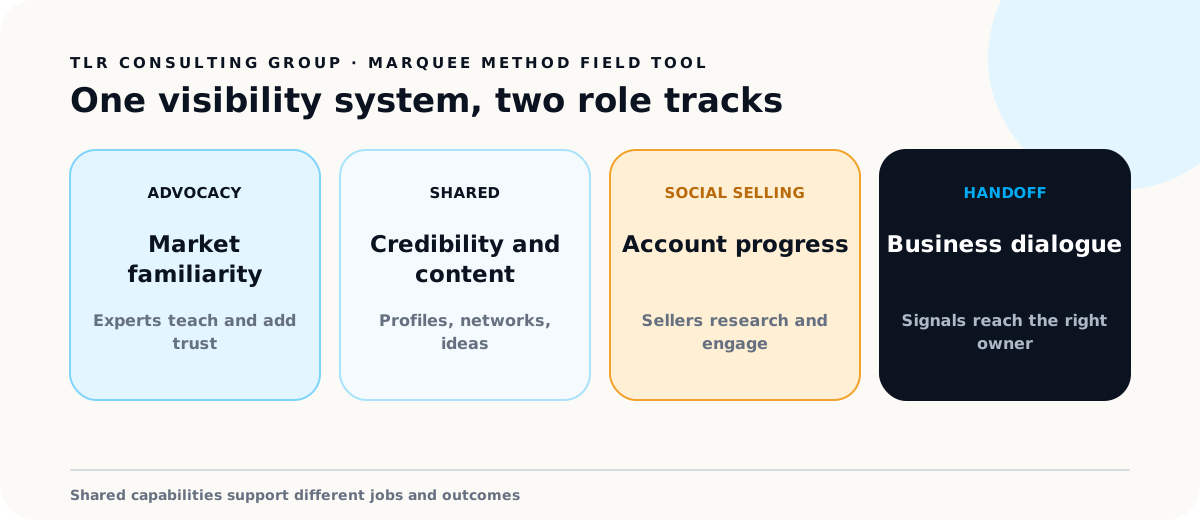
Employee advocacy is an organizational capability that helps employees contribute credible expertise and perspective through their professional networks. Social selling is a sales workflow that uses professional identity, account research, relevant participation, and relationship context to improve access and buyer conversations.
The disciplines share profiles, networks, content, and dialogue. Their jobs differ. Advocacy increases the market’s familiarity with the company’s people and thinking. Social selling helps a seller understand an account, earn access, and advance a relevant commercial conversation.
Design the operating model by role
| Role | Advocacy contribution | Social-selling contribution | Primary evidence |
|---|---|---|---|
| Executive | Market point of view | Senior relationship context | Stakeholder response |
| Subject expert | Teach decisions and tradeoffs | Support technical dialogue | Saves, questions, reuse |
| Seller | Share buyer-relevant experience | Research, engage, follow up | Access, replies, meetings |
| Marketing | Research and editorial support | Account content and signals | Audience and program quality |
| Manager | Protect participation time | Coach account application | Habit and opportunity evidence |
See how both tracks work in one account
A manufacturer launches a predictive-maintenance offer. An engineering leader publishes a practical explanation of why failure-code ownership should precede modeling. Operations leaders save and discuss the post. A seller notices that people in two target accounts engaged and uses the idea in account research.
The seller does not treat every engagement as a lead. Where a buyer has added a substantive comment, the seller continues the discussion and offers a relevant decision map. The expert joins when technical depth is useful. Advocacy created familiarity and proof. Social selling used context to support a real account conversation.
Set separate measures and a shared handoff
Advocacy measures participation, audience quality, knowledge shared, substantive engagement, and market or employee influence. Social selling measures target-account network quality, connection acceptance, response quality, buyer conversations, meetings, and opportunity influence. LinkedIn’s Social Selling Index activity framework describes LinkedIn’s activity framework, while LinkedIn’s current explanation of the shift beyond SSI cautions that SSI alone no longer reflects the modern sales environment.
Define the handoff rule. Marketing or the program lead can surface public account signals, but the account owner decides whether follow-up is appropriate. Experts should know when a seller may ask for help and retain the right to decline. This protects trust and keeps participation from becoming disguised prospecting.
Build a 90-day integrated pilot
Weeks one and two establish the shared foundation: credible profiles, target audiences, policy, and baseline. Weeks three and four train experts to capture useful ideas and sellers to map account roles and signals. Weeks five through eight publish a small body of expert content while sellers practice relevant public participation. Weeks nine through twelve connect qualified signals to account conversations.
Review the two tracks separately. Advocacy asks whether credible expertise reached and helped the buying group. Social selling asks whether sellers improved account knowledge, access, replies, and commercial dialogue. Then review the handoffs: which expert ideas sellers used, which buyer questions returned to the editorial team, and where follow-up damaged or strengthened trust.
Expand only when both tracks have clear owners, role-specific measures, and a handoff rule employees understand.
Frequently asked questions
Is employee advocacy part of social selling?
They overlap, but advocacy is broader. It can support brand, recruiting, trust, and expertise without a direct sales objective.
Can non-sales employees participate in social selling?
Customer-facing experts, executives, and customer success teams can support buyer relationships, but role expectations and metrics should remain appropriate.
Should the programs use different tools?
Possibly, but start with shared skills and workflows. Tools should reduce friction after the operating model is clear.
Research and method: This guide separates documented platform features and cited research from the operating recommendations used in The Marquee Method. LinkedIn analytics are estimates, research findings describe their stated samples, and platform features can change. Review the linked primary sources before implementing account-specific workflows.
Put it into practice
Choose the right starting point for your team.
Compare focused workshops, activation, and full-system implementation without forcing every role into the same behavior.
Compare programs